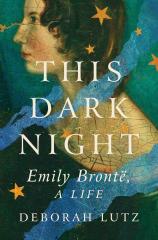
This Dark Night: Emily Brontë, A Life


Review
This Dark Night: Emily Brontë, A Life



After reading THIS DARK NIGHT and having a lot of trouble putting it down between chapters, my biggest disappointment had nothing to do with how Deborah Lutz uniquely captured the essence of Emily Brontë. It was the tragic brevity of her literary subject’s life (1818-1848).
It wasn’t until she was 27 that Emily, the middle of the three surviving Brontë sisters (Charlotte being the oldest and Anne the youngest), began writing her only known complete novel, WUTHERING HEIGHTS, and possibly another, the fate of which is a mystery. Up until then, her only published works were a few poems in an anthology with her sisters, all of whom had to adopt masculine pen names to even get their literary feet in a publisher’s door. It seemed that she was just on the verge of recognition when death came for her.
There is no shortage of biographies and semi-fictional accounts of the Brontë sisters. They include TV documentaries and feature-length films, such as the critically praised UK release, Emily (2022), directed by Frances O'Connor and starring Emma Mackey in the title role.
"Lutz...has penned what deserves to be this generation’s definitive biography of a woman whose sensory and creative expression of life spanned the microscopic to the cosmic."
But Lutz, who has five substantial books on Victorian love, life and sexuality to her credit, has penned what deserves to be this generation’s definitive biography of a woman whose sensory and creative expression of life spanned the microscopic to the cosmic. Thanks to accessing formerly unavailable records, manuscripts and notebooks of the Brontë family, Lutz draws a much richer and more detailed portrait that not only shows Emily as a fully formed personality, but reveals each sibling in a distinct light.
What brings this unusual and ultimately tragic family into focus for 21st-century readers is Lutz’s consummate skill at weaving seemingly mundane details of everyday life into the fabric of their creative existence. Alongside the practical necessities of acquiring a Victorian education, maintaining a place in society, dealing with youthful emotions and romances, encountering illness and death, and keeping a motherless household running, Charlotte, Emily, Anne and their only brother, Branwell, lived energetically in imaginary worlds they created and wrote about together --- not only during childhood, but also well into young adulthood.
Much of their imaginative fervor, especially Emily’s, was stirred by the climate and rugged landscape of the Yorkshire moors around their hometown of Haworth. Their intellectually liberal father, Patrick, was a local clergyman who largely homeschooled the children. He would outlive not only his wife, but all six of his offspring.
By drawing so deeply on the real and imaginary worlds that the Brontës simultaneously inhabited, Lutz adds meaning and relevance to Emily’s poetry, which spans her entire short life: her seeming obsession with death, graves, memorials, ghosts and the supernatural; her passion for the beauty of the night sky and contemplation of the infinite; her keen eye for the subtlest changes in the flora and fauna of the moors on which she wandered at every opportunity; and her passion for the welfare of animals. She also captures Emily’s sometimes-painful transition into adolescence and adulthood, times in which she could be both an acute observer and a vocal critic of human nature and relationships (platonic and erotic).
An especially endearing and often poignant element of THIS DARK NIGHT is the generous amount of correspondence that Lutz includes between Emily and her sisters, friends and relatives, which not only serves to highlight the intimacy of their connections, but also brings the larger 19th-century world into their quite isolated rural environment. An important part of that wider world was the innovation of affordable rail travel that arrived in Yorkshire in time for Emily and Charlotte to journey overseas to Belgium for additional schooling, an experience that deeply influenced their writing.
Lutz’s organization of the book into dated chapters provides a steady continuum in a life story with so many crisscrossing strands. While Emily Brontë is the main interest, her siblings (even the self-destroying Branwell) are never glossed over as mere accompaniment figures. Everyone has meaning and context, just as everything around and within Emily herself did.
Charlotte’s JANE EYRE may never be displaced as the most famous title produced among the Brontë siblings, but Lutz reveals just how much of all of their creativity flowed into each of their individual literary achievements. And that is only one of the many treasures that THIS DARK NIGHT has in store.
If only Emily had lived longer.
Reviewed by Pauline Finch on June 5, 2026


This Dark Night: Emily Brontë, A Life
- Publication Date: May 5, 2026
- Genres: Biography, History, Nonfiction
- Hardcover: 352 pages
- Publisher: W. W. Norton & Company
- ISBN-10: 1324037113
- ISBN-13: 9781324037118