Storm Warning


Review
Storm Warning



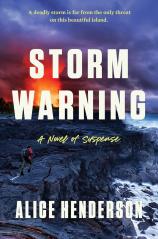
Alice Henderson's thrilling and fascinating series about Alex Carter, a wildlife biologist whose past adventures have had her studying jaguars, wolverines, polar bears and caribou, now takes her to Hawaii. In STORM WARNING, Alex has been asked to monitor a beach where hawksbill turtles are laying their eggs. The timing is perfect as she is just coming off of another job and has the time. Also, returning to the island where she lived with her parents for a while brings back fond memories.
As with all of Henderson's books, this one starts with a seemingly unrelated incident that will be relevant later in the novel. In Alaska, a gold mining crew uncovers a woolly mammoth. It gets shipped to Hawaii for study, but then a baby mammoth is discovered at the same site. Before much can be done to carefully excavate it, a helicopter appears with masked men. Not only do they take the diminutive baby mammoth, they kill everyone there.
Then the action moves to the beach, where Alex is snorkeling over a vibrant coral reef. One of the ways in which Henderson keeps the stories enthralling and filled with scenes we love to imagine as we read is to describe the wildlife that Alex is viewing in such detail that we easily can picture it in our minds. We see the sunlight playing over the coral and the "iridescent amber and brown" of the rare hawksbill turtle she observes eating sponges that grow on the reef. By breaking off pieces of the sponges, thus opening the reef, the hawksbill allows fish to reach places that they wouldn't be able to access otherwise.
"It's incredibly rewarding to read a novel that incorporates real information about our world and our wildlife, a fabulous protagonist and gripping action, while also being quite touching."
Alex sets up camp on the beach and recruits volunteers to help her watch the turtle nests filled with eggs. She can't be there every minute, and when she needs to go to the store for food or other supplies, someone else will ensure that predators like dogs, raccoons and humans don't disturb the nests. As we find out, humans can be the deadliest predators around. One of the volunteers is a scientist at the nearby Museum of Vertebrate Paleontology, where the Alaskan mammoth was originally taken for study.
While Alex is trying to count endangered turtle eggs and shield the nests, she's also protecting the wildlife in the ocean from illegal gillnets that kill indiscriminately. It traps one of the turtles Alex has tagged with a sensor, so she is able to save the turtle and remove the gillnet. A hurricane is approaching, and Alex will have to figure out how to move the eggs to safety so they don't drown in the storm surge. That turtle eggs need protection from drowning is one of the many fascinating things that we learn about wildlife in this series.
As the storm approaches, the real bad guys appear. The events from the prologue make sense as we see the ensuing danger to Alex, the museum and the world at large. Alex becomes almost a superhero as she dodges and intrepidly takes action to stymie the villains. It's like watching a movie where we know you don't go into the basement because the monster is there, but the character does anyway. That's what we feel as Alex makes move after move to thwart the evil plan of a billionaire who will never be satisfied with his money.
Henderson writes what so many people feel these days about billionaires trying to control everything --- what the media reports on, what networks air, who is allowed in our country, who goes to war and who profits from it: "And why was it that the richest people seemed to be the most obsessed with acquiring more wealth, even turning to unethical means to get it?" (Billion-dollar trades in oil mere minutes before public statements about war come to mind here.)
What I and many readers adore about Henderson's novels is the wealth of information she provides about not only the species that is the main creature in the story, but others as well. Here we learn about how climate change is decimating the population of sea turtles. "Turtles get killed in staggering numbers when they get caught in fishing nets. They're also crushed by dredges used in shellfish hunting. They're even sucked up by nuclear power plants that use seawater to cool their reactors." Henderson goes on to explain that humans also harm turtles by building resorts and housing developments on beaches where they nest. Seawalls rob the turtles of their egg-laying beaches, and climate change causes more destructive storms that erode beach habitats and drown turtle eggs in their nests.
While each of these books can be treated as a stand-alone, the overarching story about Alex and her family; her best friend; and Casey, the mystery guy, makes it a great series to dive into from the start. It's incredibly rewarding to read a novel that incorporates real information about our world and our wildlife, a fabulous protagonist and gripping action, while also being quite touching.
Reviewed by Pamela Kramer on March 27, 2026