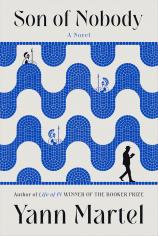
Son of Nobody


Review
Son of Nobody



Just in time for this summer’s blockbuster movie, The Odyssey, Yann Martel crafts a brilliant Trojan War novel that fills gaps within Homer’s epics and even in present-day mythologies.
SON OF NOBODY revolves around Psoas, a Greek commoner who becomes a somebody, and Harlow Donne, the Homeric scholar at Oxford University who discovers Psoas’ lost epic. Through the mythology of Psoas and the Trojan War, and through Donne’s academic and personal footnotes, Martel puppeteers two narratives that are separated by millennia but tell a unified story. This book is an instant pillar in his catalogue, right alongside LIFE OF PI.
Readers who are eager to dive into the neglected, lower-class perspective of the Trojan War might mistakenly skip the Author’s Note. This passage’s numbers are not in prescient Roman numerals, but in the same numerical count as the rest of the book. This opening note is not Martel’s, but Donne’s, and lays the novel’s framework. Psoas’ epic, The Psoad, is in the upper halves of each page, with Donne’s footnotes in the lower halves below a thick black line. Part of what makes SON OF NOBODY a page-turner is that, like with Homer’s epics, readers will flip from The Psoad to the corresponding footnotes and vice versa.
Some footnotes, like how the epic calls the Greeks “Argives,” are for historical context and in current copies of THE ILIAD and THE ODYSSEY. Others tell the tale of Donne, how he neglects the intended study of his Oxford scholarship to unearth The Psoad, and the effects that his year-long absence has on his wife and daughter. Each page develops the stories of Psoas, Ancient Greece and Donne, which is nothing short of a triumph of Martel’s talent.
"...a brilliant Trojan War novel that fills gaps within Homer’s epics and even in present-day mythologies.... Throughout SON OF NOBODY, Martel juggles multiple literary mechanics like a trained Cirque du Soleil performer."
After his note to readers, Donne presents his research’s thesis in his abstract. While THE ILIAD and THE ODYSSEY laid the foundation for Western culture’s heroes and storytelling norms, The Psoad was a precursor to Jesus of Nazareth, the West’s foremost story of a commoner who triumphs. Though Jesus is described as the son of the Hebrew god, and certainly not the son of a nobody, both he and Psoas are ordinary, working-class people. Psoas is a former cheesemaker turned soldier, and Jesus is a carpenter.
Martel avoids producing a novel that falls into the “shaggy God” subgenre by writing Donne’s theories of Jesus’ mythology like a scholar’s summation of his research. Donne even details why his footnotes are told from his perspective. He believes himself to be a failure, so writing like a polished academic is disingenuous to him. Part of why he first diverged from his assigned research is that he felt that discovering The Psoad could have made him a significant voice in his field. A somebody and not a nobody.
In The Psoad, Psoas and the Greek army manage to infiltrate a working-class district of Troy. Paris and Hector instigated and battled in the Trojan War, and that’s about all THE ILIAD tells of Trojan society. In addition to highlighting commoners’ perspectives of the war, and relegating Achilles, Odysseus, Agamemnon and the Greek ruling class to side characters, The Psoad showcases Troy beyond treacherous enemies. As the Greeks are razing the Trojan working district, Psoas meets Elanthius, a Trojan table maker. He asks Psoas what he is fighting for. Psoas hoped to bring home looted Trojan treasure to his family, but he is always forced to trade his spoils to stay alive. Elanthius lost his family to illness and misfortune, and the two bond over lost time with their loved ones.
One night in Oxford, Donne sees his scholarship supervisor, Franklin Cubitt, stumble on the street. Donne helps him up, and Cubitt reveals that he misses his late son. When Donne tells Cubitt about his daughter, who is an ocean away, Cubitt asks him what he’s doing in Oxford and to “go home, man.” Martel does an extraordinary job linking a mythical character’s woes of a journey that keeps him from his family with a modern character’s guilt over missing a year with his loved ones to advance his career.
Throughout SON OF NOBODY, Martel juggles multiple literary mechanics like a trained Cirque du Soleil performer. The Psoad uses repetition and poetics to emulate an ancient story transcribed from centuries of oral tradition. Within Donne’s footnotes, there are two more tones. The contextual, academic footnotes are still first person, allowing Donne to showcase his personality, like when he acknowledges common interpretations of gods that sound like James Earl Jones or Morgan Freeman. In the footnotes about Donne’s personal life, Martel gives readers an intimate character study with which to connect. Donne tries to balance the energy he feels in discovering The Psoad and the guilt he has with leaving his daughter and neglecting his marriage.
In Donne’s personal footnotes, Martel plays with narrative time masterfully. Most of them are in his “Psoadic” excavations at Oxford. But the time jumps backwards when Donne details how he met his wife while studying for his master’s and how their marriage gradually deteriorated. Martel jumps ahead in time when Donne describes the dingy apartment he lives in when he writes the footnotes, foreshadowing his life after his scholarship. Even The Psoad jumps with time when it shifts from Psoas’ early days in the Trojan War to a veteran with a decade of experience and resentment.
Despite constant variation of tone and time, SON OF NOBODY maintains unity when Donne and Psoas quietly ask if love should ever be sacrificed.
Reviewed by Sam Johnson on April 3, 2026


Son of Nobody
- Publication Date: March 31, 2026
- Genres: Fiction
- Hardcover: 288 pages
- Publisher: W. W. Norton & Company
- ISBN-10: 132411813X
- ISBN-13: 9781324118138