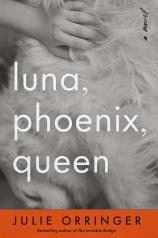
Luna, Phoenix, Queen


Review
Luna, Phoenix, Queen



Julie Orringer's first two novels, THE INVISIBLE BRIDGE and THE FLIGHT PORTFOLIO, were set in Europe in the World War II era and weighed in at more than 500 pages. Given their success, and the passage of seven years since the latter's publication, it wouldn't have been surprising if Orringer had continued to mine that lode for works of similar subject matter and scope.
Instead, in LUNA, PHOENIX, QUEEN, Orringer has written an intimate contemporary drama that's both a thoughtful portrait of a family's struggle with a wife, mother and lover's early-onset dementia, and a profoundly imagined exploration of the destructive power of secrets. At the heart of the story is a remarkable dog who provides a considerable amount of its emotional resonance and helps bring it to an unforgettable climax.
"Orringer has written an intimate contemporary drama that's both a thoughtful portrait of a family's struggle with a wife, mother and lover's early-onset dementia, and a profoundly imagined exploration of the destructive power of secrets."
The novel is set in a Midwestern university town that's suggestive of Iowa City, where Orringer earned her MFA from the Iowa Writers' Workshop in 1996. It focuses on Dava and Barr Pennington, tenured professors in their late 50s at the university. She specializes in early 20th-century American literature, and he, the author of several modestly successful novels of “middle-American realism,” teaches creative writing. There's a mismatch in their status that contributes to a feeling that their marriage, even in its better days, has been more businesslike than romantic.
As the book opens, Dava has entered a nursing home to receive care for her slowly progressing early-onset Alzheimer's disease after several years of Barr's care at home. Just as we're settling into the story, Orringer introduces a sharp plot turn --- Barr's discovery of dozens of legal pads on which Dava feverishly had been writing the draft of a novel in secret. It's a fictionalized version of her late mother's love affair with a female coworker at a women’s shelter, “a deftly worded love letter hundreds of pages long” that, to Barr, confirms his suspicion of Dava's long-running affair with a colleague, Svetlana White, a professor of Slavic Studies.
With this material in hand, Barr decides to revise and finish the novel, as he had “begun to think of it as his own.” But in a stunning act of literary misappropriation, rather than giving any credit to Dava, who long ago lost the capacity to complete the work or to raise her voice in protest, he offers it to the world as his solo creation. In the process, he earns considerable attention for his flagging literary career. That fateful decision provides the engine for the remainder of the novel's plot.
It would be a disservice to Orringer to reveal any more of that plot's complications. But over the balance of the story, in one artfully crafted scene after another, she patiently and attentively reveals the tensions in the Penningtons' marriage; the arc of the beautiful, but furtive, relationship between Dava and Svetlana; the repercussions of events in the lives of the Penningtons' sons, Milo and James, and Svetlana's daughter, Naomi; and the role of Barr's research assistant Evie, a young woman with her own family pain, in this complex dynamic.
One of the most compelling of the novel's threads is the story of Luna, a dog Barr discovers online in a shelter. She's “thin and horribly burned, her skin convoluted and only half healed, her poor ear gone, her face rearranged by fire.” Barr instantly identifies with the dog's plight, feeling “he knew what it felt like to be trapped, to have lost control of one's own narrative, to have suffered, to have been scarred by events beyond one's control.”
Though she lacks the true power of speech displayed by the canine protagonist in Paul Yoon's recent novel, ETNA, Luna possesses a preternatural ability to communicate with humans and to evoke a powerful emotional response, not only from Barr, but also from most of the other characters. It isn't until the book's final pages that Orringer brings the dog's story to a climax. When she does, it lands with breathtaking force.
Orringer knits this all together with consummate skill, unobtrusively shifting points of view among Barr, Svetlana, Evie, Milo and James, and moving backward and forward through time without inducing any feeling of disorientation. If anything, her depiction of Dava's tragic decline is understated in a way that somehow causes it to land with more impact. That may have something to do with the fact that Orringer wrote the book in the shadow of her husband, writer Ryan Harty’s, own diagnosis of early-onset Alzheimer’s. “We’re in the grip of something unimaginable. We long for some kind of control,” she told an interviewer in a recent New York Times profile, a status that aptly describes the plight of the characters in her novel.
Unlike Orringer's previous novels, LUNA, PHOENIX, QUEEN doesn't rely on any world-altering events to propel the story, but it's no less impressive for that fact. Instead, her raw material is the often unacknowledged drama that arises out of the stuff of daily life. With a heightened sensitivity and an acute eye for detail, she reminds us to attend to those moments before they slip, unnoticed, from our grasp.
Reviewed by Harvey Freedenberg on October 15, 2026


Luna, Phoenix, Queen
- Publication Date: October 13, 2026
- Genres: Fiction
- Hardcover: 288 pages
- Publisher: Knopf
- ISBN-10: N/A
- ISBN-13: 9798217207886