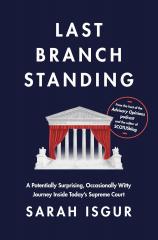
Last Branch Standing: A Potentially Surprising, Occasionally Witty Journey Inside Today's Supreme Court


Review
Last Branch Standing: A Potentially Surprising, Occasionally Witty Journey Inside Today's Supreme Court



For the greater part of its 236 years of existence, the United States Supreme Court has been the least discussed of the three branches of government. While significant decisions were covered by some journalists, the justices toiled in relative obscurity. Few Americans could even name them.
But this began to change in 1979 when Bob Woodward and Scott Armstrong went behind the curtain that cloaked the Supreme Court in secrecy. Even then, Woodward was known for his remarkable ability to report by using “off-the-record” sources. THE BRETHERN was an extraordinary inside look at how the Court operated and how cases were decided. Perhaps more importantly, the book’s publication led journalists to expose the Court as a political institution with similar faults and foibles to the other branches of government.
"Isgur is not simply a reporter of legal decisions. On many occasions, these reports are presented like sporting events.... LAST BRANCH STANDING is a fine and enjoyable book that people of any profession will find worthwhile and educational."
Reporting and writing on the Supreme Court is now a regular occurrence. Confirmations are epic battles that often lead to exhaustive news coverage. Towards the end of each term, when major rulings are announced, the press is everywhere. One such journalist is Sarah Isgur, the editor of SCOTUSblog, a regular on ABC’s “This Week with George Stephanopoulos,” and the co-host of “Advisory Opinions,” the nation’s top legal podcast. Her considerable political and legal experience has provided us with a witty and thorough study of the current Court. LAST BRANCH STANDING is insightful, sometimes unexpected and thoroughly entertaining.
Isgur is not simply a reporter of legal decisions. On many occasions, these reports are presented like sporting events. To her, the justices are neither heroes nor villains. They are real people doing their best to serve us all and often struggling to accomplish that goal. As an illustration of her argument, she compares two members of the Court who are on opposite ends of the political spectrum: Clarence Thomas and Sonia Sotomayor. Both attended the same law school and graduated in the same decade. Both believe that race played an important role in their admission. Both experienced discrimination because white people presumed they were not qualified. But their legal takeaways and views of the Constitution often result in far different decisions.
There are many explanations as to why similar cases yield what appear to be dissimilar outcomes. Isgur offers several theories. Simply put, cases that appear to be similar present different facts and legal records, leading to different conclusions. However, they typically are reported not by their differences but by their broad similarities. For example, not all criminal cases are the same. But journalists often treat them as such because explaining the differences makes the story more difficult to report.
LAST BRANCH STANDING is loaded with interesting legal information presented with grace and in a non-stuffy, non-legal manner. Isgur has a lengthy chapter where she presents biographies of the current justices and seems to make every effort to emphasize their strengths while avoiding discussions of some of their weaknesses. She also spends a substantial part of the book explaining the nuances of Court practices, including oral arguments, case assignments, and the present-day onerous “shadow docket” that seemingly allows them to make bad decisions without fully disclosing their reasoning.
There is one problem the Court exhibits that I wish Isgur had discussed. Presently it has become a closed fraternity of Ivy League-educated lawyers both serving on it and appearing before it in cases and arguments. It should not be that type of body. It’s a big country out there with quite a few fine attorneys and judges who attended non-Ivy League law schools and practiced law outside Washington, D.C. They are certainly capable of serving on the Court. Many justices who brought that type of diversity to the Court previously had exemplary careers and wrote noteworthy opinions.
Overall, LAST BRANCH STANDING is a fine and enjoyable book that people of any profession will find worthwhile and educational.
Reviewed by Stuart Shiffman on May 1, 2026


Last Branch Standing: A Potentially Surprising, Occasionally Witty Journey Inside Today's Supreme Court
- Publication Date: April 14, 2026
- Genres: Law, Nonfiction, Politics
- Hardcover: 416 pages
- Publisher: Crown
- ISBN-10: 0593800923
- ISBN-13: 9780593800928