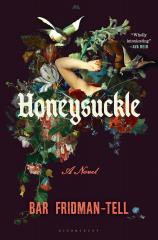
Honeysuckle


Review
Honeysuckle



In Welsh mythology, Blodeuwedd, which roughly means “Flower-face,” is a maiden created out of flowers and plants by two magicians for the hero Lleu Llaw Gyffes. The story of Blodeuwedd includes affairs, curses and murder plots and ends with this magical creature being turned into an owl.
In her debut novel, HONEYSUCKLE, Bar Fridman-Tell begins with the premise of a companion created out of flowers and then takes the tale in some interesting directions, examining themes of love, freedom, friendship and identity.
"HONEYSUCKLE offers readers a thoughtful exploration of consent, control, creation, choice and liberty.... This promising first outing is a compelling blend of fantasy, light horror and domestic drama, resulting in a unique coming-of-age story."
Rory and his sister, Wynne, are essentially on their own on a large country estate. Their divorced parents have left them behind while they work, travel and adventure. A tutor is responsible for their educations, and a mostly disinterested housekeeper sees to their meals and maintenance. Wynne is six years older than eight-year-old Rory, and she is annoyed by his attention and needs. She makes him a playmate, Blodeuwedd, out of the flowers and branches that grow on their land, hoping to both alleviate his loneliness and give herself a break.
Rory gives Blodeuwedd the name Daye, and they become fast friends and constant companions. However, Daye needs to be remade at the turn of each season as her natural parts disintegrate and decay. Wynne only reluctantly rebuilds her, growing concerned that Daye has become Rory’s whole world.
As the years go by, Rory begins to see Daye differently, noticing her beauty and wishing she had the desires for him that he feels for her. Wynne teaches Rory how to care for Daye when she leaves for college. Without her supervision, he is able to make changes to Daye’s body season by season. Soon their relationship becomes sexual, and Rory also must study at the university to learn more advanced skills to try to keep Daye alive longer. He leaves Daye alone for lengthier periods as he studies. While away, he makes friends and sees more of the world apart from the home where he was isolated for so long. In HONEYSUCKLE, the world is like ours but tinged with magic that creates “constructs” like Daye and the experiments Rory keeps in a shed at home.
While Rory gains physical and intellectual freedom and opportunities, Daye’s world remains limited, and it becomes increasingly clear that she has little autonomy in her relationship with Rory. The world is full of danger for her, but Rory’s disregard of her needs and wants feels most dangerous of all. As Rory bonds with other humans, Daye finds connection with the natural world of which she is a part, especially with birds. She begins to understand her true self and comprehend Rory’s selfishness, as well as his obsession with and objectification of her.
Ultimately, Daye must make a difficult decision. While Rory grows up, he never grows emotionally, and perhaps her only option is escape.
HONEYSUCKLE offers readers a thoughtful exploration of consent, control, creation, choice and liberty. While the novel is a bit repetitive and slow at times, Fridman-Tell often builds a good amount of tension, and her descriptive skills shine in the narrative. This promising first outing is a compelling blend of fantasy, light horror and domestic drama, resulting in a unique coming-of-age story.
Reviewed by Sarah Rachel Egelman on March 27, 2026