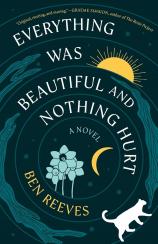
Everything Was Beautiful and Nothing Hurt


Review
Everything Was Beautiful and Nothing Hurt



From debut author Ben Reeves comes EVERYTHING WAS BEAUTIFUL AND NOTHING HURT, a fascinating portrait of a man who none of us know but all of us will meet one day: Death himself, of course.
Reeves’ protagonist, Travis, bears none of the trademarks we’ve come to expect. He doesn’t wear a black robe, he doesn’t carry a scythe, he doesn’t decide who dies, and he doesn’t determine where they go after. He simply wanders, observing the quiet hours of night before the morning sun rises. He visits men, women and children, each of whom knows instantly who he is and why he is there.
Travis’ first visit, to a single-car crash, introduces readers to 29-year-old Samuel Preston, who has just wrecked his vehicle after driving on a cocktail of Jägermeister and pills. Samuel’s girlfriend is pregnant, and he plans to propose soon. But once he sees Travis, he knows he will miss it all. Travis tells him the things a person should only know right before they die. Caught in the flashing red and blue lights of the police cars that have rushed to the scene, he clutches the bracelet he once hung from his rearview mirror. Its smell is the last thing he knows.
"EVERYTHING WAS BEAUTIFUL AND NOTHING HURT is a balm, a salve, a gift. And perhaps, most potently of all, it is an urgent reminder to do the thing that you will wish on your deathbed you could have done one last time."
So it goes for Travis, day in and day out: a woman battling terminal cancer in hospice, a lonely old man, an abuser who chokes on a sandwich, unknowingly giving his victims the chance to breathe again. By day, Travis restores physical photographs, helping doddering old men and women recapture their youth and the stories of their lives again.
One day, a chance encounter with the woman who lives across the hall from him, Dalia, introduces him to her eight-year-old daughter, Layla. Precocious and bright, and possessing a mind entirely her own, Layla becomes enamored of Travis: his peculiar, bland-dressing style, the way he always answers a question with a question, the comfort he brings her single mother, who recently has given her a baby sister, Neda. But the astute reader will know that there are no chance encounters with Death, no cozy friendships with the harbinger of all that we fear. Dalia and Layla’s budding friendship with Travis can mean only one thing: one of them is sure to die.
But before that crushing moment, Travis starts to learn what it means to live: the comfort of a home-cooked meal, the delight of a child donning a Halloween costume she thought up on her own, the camaraderie of two adults sharing the quiet, liminal hours of the night, feeling as if the moment belongs to them and them alone. Although Travis continues to usher people to their deaths, he finds that the detachment that has gotten him through so many death scenes --- violent, calm, gory, transcendent --- has started to crumble. He has loved every single person he has walked into the afterlife, and he remembers them all. For the first time, though, he wants someone to live, and the responsibilities of his job seem daunting, cruel and unfair. But death comes for everyone, and Travis is committed to his work.
It is worth mentioning here that Dalia, an accomplished midwife, is something of a foil to Travis: she brings life into the world, he takes it out. She, too, has witnessed death --- the horrible blue of an infant’s lips, the screams of a mother --- but her work is enmeshed in giving life, in celebrating first breaths and cries, and the wonder and awe on a new parent’s face. Travis also has dealt in wonder and awe. But seeing the opposite of his life’s work in Dalia, he starts to appreciate not just life’s final moments, but the breathtaking scope of a life lived, even one that barely has had the chance to start.
In alternating chapters, Travis continues his work, bringing death to all manner of men and women. Everyone, he says, “knows who I am and why I’ve come. Everyone knows, at the end.” In moments tender and transformative, he sits with these people, listening to their stories, reading their poetry, reminiscing about the love they shared and the love they squandered. But most memorable is an 89-year-old woman with whom he spends every birthday, who greets him excitedly, hopeful that it is finally her time. Travis’ visits with her form a sort of refrain throughout the book, a reminder that not everyone despairs at seeing him.
Juxtaposed against Travis’ relationship with Dalia and Layla, his bond with this elderly lady speaks of an urgent, searing undercurrent. Something is coming that will shock and transform readers, even as we watch Travis continue to take life after life. This reveal alone is enough to call this book a winner, making it far more than the sum of its parts.
Although it stars a literal harbinger of death, the novel is a surprisingly moving depiction of life: the beauty of its ordinary details, the stories that keep us alive, and a reminder that every moment counts. Addressing his “victims” directly, Travis explains, “People amaze me. All of you. Every single one of you amazes me. The things you’re capable of. The pain you’re capable of enduring…. You are resilient. Adaptable. Capable of so much love, it astounds me. I would give anything to feel what you feel.” And that’s what this gorgeous, transcendent novel is really about: the sheer miracle that is a life lived, a feeling felt, a love beloved.
I’d urge readers who are recently bereaved to tread lightly, but EVERYTHING WAS BEAUTIFUL AND NOTHING HURT is a balm, a salve, a gift. And perhaps, most potently of all, it is an urgent reminder to do the thing that you will wish on your deathbed you could have done one last time. For all you know, you could have only minutes remaining to do it.
Reviewed by Rebecca Munro on July 10, 2026


Everything Was Beautiful and Nothing Hurt
- Publication Date: July 7, 2026
- Genres: Fiction
- Hardcover: 256 pages
- Publisher: Avid Reader Press/Simon & Schuster
- ISBN-10: 1668216361
- ISBN-13: 9781668216361