
Excerpt


Excerpt
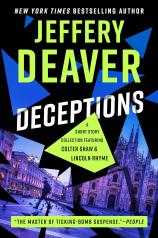
Deceptions



The Bookkeeper
A Colter Shaw Story
God made the integers; all else is the work of man.
-Leopold Kronecker, German mathematician
Too late.
The killer that Colter Shaw had been trying to intercept had gotten here first.
Or the flashing police lights and dozen officers outside the library were merely a coincidence and something else was amiss.
But Shaw did not believe in coincidences.
A man of percentages, even without the benefit of all the facts, he assessed it ninety percent likely that his prey was behind the disturbance.
The building he was looking at was the library of the New School for Social Thought, in Greenwich Village. The institution was hardly neo-Gothic. It was essentially a bland office building.
But the good news, at least, was that the killer had not killed. It seemed, instead, the break-in was a fact-finding mission. A real-life Wikipedia search to track down the details that would help him in the murder he had planned.
Shaw deduced this from the low-key police response-two blue and white cars and an unmarked. No ambulances, no SWAT.
To make sure, though, he asked a woman officer, standing beside one of the patrol cars, "No one hurt, right?"
"Move along sir now" was the reply. A punctuation-free utterance.
Shaw was a civilian. But his work often brought him into contact with LEO, law enforcement officers. They could make his life miserable, or they could help considerably, and so he made sure to minimize the antagonism-and make their lives as easy as possible. Which could only help his.
"I might have some knowledge of what happened." She eyed him up and down. Shaw, thirties-ish, wore black jeans and a black sport jacket, a gray shirt, collared. He was six feet tall with short blond hair and an agreeable smile, which, at the moment, he deployed mostly for effect. His go-to expression was low-affect observant. Inscrutable was a word often used.
"You see something?"
"No. I had an appointment with the librarian about a matter."
"A matter."
"That's right," he told S. Lopez.
From the name badge.
"Can I see some ID?"
He took out his driver's license.
She looked it over and, without saying a word to him, photographed it and sent it to wherever in the police heavens images of driver's licenses went.
Usually at a moment like this, he also handed over his concealed-carry license. New York was now a shall-issue state, meaning anyone who met the requirements for carrying a hidden pistol was issued a permit. But those requirements included NY residency and did not allow reciprocity; the carry tickets from other states meant nothing here. Shaw, who used his pistol infrequently but was always happy to have it handy, was a Florida resident.
So though his assignment was the sort for which a gun might prove helpful, he did not have his Glock with him.
Never break the law.
This was one of his father's famous and occasionally infamous Never Rules that he'd drilled into the psyches of Shaw, his older brother, Russell, and their younger sister, Dorion.
Officer Lopez continued to look at her phone.
He came back warrant free (such had not always been the case), and she said, "Wait here."
She trooped off and returned a few minutes later with a detective. Young to be a gold shield, Shaw thought. In fact, he looked a bit like Shaw himself: lean, athletic and blond. Wearing an inexpensive but pristine go-to-church suit, somewhere between powder and navy blue.
"Mr. Shaw." Wasn't a question. No point for it to be. "You know something about this?"
"I'm a-"
"Reward seeker," the detective said. "I just looked you up. You go after rewards for missing people and escaped convicts. And bad guys we cops can't find."
"That, rarely." Another smile was offered. He really needed to get into that building. And quickly.
"There some reward here?"
"That's right. The offeror's a nonprofit, the Institute for the Freedom of Journalism. It's an outfit that protects journalists and funds the legal defense of reporters and writers around the world. They got word that a professional hitman has come to New York from Brussels to kill somebody."
The detective blinked and frowned. In his short time on the job, this would be a unique crime. Shaw guessed, though, that in a law enforcement career of any length, international professional hits were uncommon. "Well, now, sir, that's police business. If this institute thought there was a threat, they should have contacted the police directly, not sent you."
"They did, Detective. The FBI too. Nobody followed up."
A frown. "Hm. I'm sorry about that. We've got thirty thousand officers in New York City. But it's not enough."
"In fairness, the report doesn't have a lot to go on. That's what I'm doing here. Trying to find the victim."
"This organization doesn't know?"
"No. The contact who sent them the information about the hit? It was a reporter in France. He disappeared."
A broader frown appeared on the cop's face. "You think they were killed?"
"Or threatened into going silent, I don't know. But I'm trying to find the victim. When I do, I'll get them into protection and then look for the killer."
The detective nodded at the library. "Why here? You must've had a lead."
"That's right. Apparently, the victim is looking into an authoritarian regime in Eastern Europe. That's what the library specializes in. I was coming here to talk to the director, see if he might know anybody doing work recently in that area."
"So maybe your killer had the same idea," the detective offered. He wasn't as young-looking up close.
"Maybe. What happened?"
"Smash and grab. The doer kicked the back door in, found the office and stole the library director's laptop."
A grimace crossed Shaw's face. Not good. Imagine the wealth of information on it.
Jotting notes in a real honest-to-God cop notebook, Lopez asked, "You have anything on this . . . person, the killer?"
"I'll admit, it sounds funny, but he works for a chocolate company."
"Does sound funny. Keep going."
Shaw said, "But that's a cover. It's really a dirty-tricks outfit. Misinformation. Hacking into elections."
"Assassination too, I guess."
Shaw nodded.
"For Russia?"
"Any Eastern Bloc country that wants to quash democracy. It's a for-hire outfit."
"So mercenaries with computers. And the occasional gunman."
"Exactly." He was pleased the cop hadn't just laughed at his preposterous idea and told him to get the hell out of his sight. "Oh, and we know his nickname. The Bookkeeper."
"Because he plans everything out, all his hits? Every detail."
"No. Because he really is one."
"A bookkeeper?"
"That's right."
"Who's also a hitman . . . And you can't get a description or picture because the chocolate bar company's not inclined to be cooperative."
"I don't think they make bars. But that's right."
"Okay, Mr. Shaw, sir, I'll report this up."
Shaw's expression offered: Why should they change their minds now?
The detective jotted some notes and asked for details of the institute and the chocolate company.
Shaw recited them.
"Brass'll decide how they want to follow up. I'm going to tell you, sir, Mr. Shaw, we can't have you investigating a case involving a possible homicide. Against all the regs. Not like a missing kid-you're free to search to your heart's content. But criminal? Nope."
"Understood. But . . . I've got an appointment with the director."
Then, after a long pause, the man made an expression that was positively coy. "But if you happened . . . just happened to fall into the category of, maybe a witness, then I suppose it couldn't hurt to help refresh your memory by talking to the director, see if there's anything you could remember that could help me find the burglar. I don't think anybody'd have a problem with that."
"Fair enough." Shaw appreciated the man's gesture. He was one of the good ones.
"But you get a name or lead to anybody-the victim or this Bookkeeper-I'm the first person you call. That understood?"
"Clear as crystal," Shaw replied.
"I hope so. I would prefer not to have to arrest you for obstruction."
Shaw told him that was his preference too and offered one of those dubious smiles to back up his words.
Was the answer here?
As he sat in a coffeehouse, authentically Italian, as were many in lower Manhattan, he was asking himself this question.
The stocky bearded man of dark features, forty-six years old, and wearing the typical business clothes of a typical businessman, was typing away at a laptop.
The answer, the clue, the lead . . .
Scrolling through file after file.
No, not yet.
As Stavros Drall searched, his mind wandered.
To where it often went when doing repetitive work:
The world of numbers. His first love.
Numbers . . .
A subject with a fascinating history, which he found himself reflecting on with some frequency.
Cave people tallied with burned bone and sticks-but that didn't really "count," he sometimes thought and would laugh at the English pun. As for the first true numerical system, it was the brainchild of the Sumerians, 3000 BCE. They had a base-sixty scheme-imagine (we use the bush-league base-ten). Then came the Egyptians, who used hieroglyphic numerals for construction and a subject near and dear to the man, accounting. The Greeks had an alphabet-based system, akin to the folks on the southern side of the Mediterranean. The Romans had that system we all know from trying to figure out the date of movies in the credits. It worked well enough but without a zero was pretty useless for calculations.
As for the South Asians-500 CE saw the introduction of Hindu-Arab numbers, which we recognize today. It was in their system that the miraculous 0 appeared-a true number, not just a placeholder. The results were arithmetic and algebra. From there the evolution raced forward. The Islamic scholar al-Khwarizmi-we get "algorithm" from the name-and others continued to explore what numbers could do, though in a more philosophical sense. Finally, Fibonacci's Liber Abaci, in the thirteenth century, brought 0 through 9 to Europe.
And commerce and science exploded exponentially.
Few other changes occurred until the 1950s, when the simplest system of them all rose to prominence: Binary.
Which used only 0 and 1.
And made the whole digital world possible: nearly all software, no matter how complicated, operated on those two numerical siblings alone, including the data he was currently scrolling through on the computer he had just stolen.
He was searching for something-the faintest, the most insubstantial of clues, which could, however, like fanning an ember, burst to flame.
And reveal the identity and the location of the person he was supposed to murder.
Intelligence services in his home country had reported that someone-no information more specific than that-was on the trail of a document, which, when made public, would be very bad for certain important people.
After being smuggled into the country through Canada, he had found a lead: the document he sought was likely in the archives in the library of the New School for Social Thought in Manhattan, where it was among materials donated by an activist who'd committed suicide in Bucharest. (What other explanation might there have been for a fall from his tenth-story apartment window?)
Drall's mission was to find and destroy the document and murder the reporter or activist who was searching for it.
And so it was to this library that he'd hurried.
The laptop he'd stolen, though, provided no helpful information whatsoever. The facility did not log visitors or what they searched for. Drall realized this was intentional-to prevent people like him from learning researchers' IDs. He came to the last file and returned the computer, useful only as a paperweight-to his backpack.
The setback was merely an inconvenience. A classic accounting question. In the balance sheet of this operation, an entry had been made on the debit side.
But that meant there was a corresponding entry on the asset side.
He would now cash in.
He lifted a finger to his nose and smelled tobacco. He missed his French cigarettes. There was no smoking on a job, ever, of course (left far too many clues-and drew far too much attention). Ah, the damn Western world, so worried about health and safety.
So he had to make do with the comforting aroma.
He placed a call on a phone that would be, by morning, in a landfill somewhere in the tri-state area.
"Yeah?" The man's voice was gruff.
"Anthony. It's me." Drall was athletic and stern looking-hardly the stereotype for a bookkeeper-but his voice was high and smooth. It was graced with a lilt.
"Oh." The man, somewhere in the suburbs of New Jersey, now turned instantly respectful. And a bit afraid.
Good. The way associates should always be.
Anthony said, "You found what you were looking for?" In professional relationships like these, conversations were always obscure in the extreme.
"I'm close. What we talked about. I'll need the package."
"You bet, brother," the man said quickly. "Just tell me when and where."
Drall had never met Anthony or his crew but knew something of them. They were big and bearded and crude . . . and efficient in their deadly or injurious missions. And though they were, to a person, American through and through, they had passionate sympathies for what Drall's employer stood for and what he had sent Drall to accomplish: the end of Western governance.
"As soon as possible. I'll text the address."
He glanced out the window, thinking again of his new plan.
Yes, it should work.
"And there's something else I need."
"Sure. What?"
No one was close by, but in this world, caution reigned.
"I'll text that too."
He sent the missive, put the phone away.
Drall fished money from his pocket with his knuckles, so as not to leave prints, and rose, slipping outside to get to work.
One day earlier, Colter Shaw had met with a woman named Yvette Merton, an assistant at the Institute for Journalistic Freedom, located in an old town house on the West Side of Midtown Manhattan.
The organization was offering the reward to find the Bookkeeper and his victim.
"He's here to kill several people," she had told him. "Our sources think the first is a journalist doing some work to expose a strongman in Central or Eastern Europe." Merton had grimaced. "The source thought the target might be a journalist doing work at the New School for Social Thought, downtown."
A starting point-the only starting point-in Shaw's search.
Now, twenty-four hours later, the assessment had been proved correct: since the Bookkeeper had broken in, searching for the same thing Shaw was.
Excerpted from DECEPTIONS by Jeffery Deaver. Copyright © 2026 by Jeffery Deaver. All rights reserved. No part of this excerpt may be reproduced or reprinted without permission in writing from the publisher.


Deceptions
- Genres: Fiction, Short Stories, Suspense, Thriller
- hardcover: 304 pages
- Publisher: G.P. Putnam's Sons
- ISBN-10: N/A
- ISBN-13: 9798217186129


